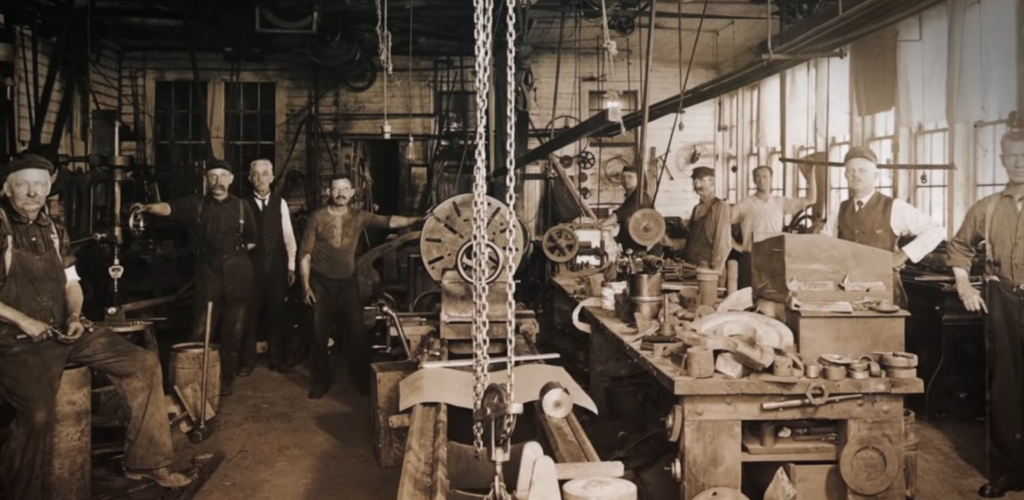
Credits to HISTORY
Birmingham, Alabama has a long and complex history with the American labor movement. From the early 20th century to present day, Birmingham has been a site of contentious struggles between workers and their employers. Let’s explore the history of this relationship, looking at the key events and actors that have shaped it over time.
Birmingham’s labor history can be traced back to the industrialization of the city in the late 19th century. In the decades following the Civil War, Birmingham transformed from a small town to a thriving industrial center. The city’s rich natural resources, including coal and iron ore, attracted entrepreneurs who saw potential in the area. With the help of cheap labor and favorable business conditions, these entrepreneurs established a range of manufacturing industries in Birmingham, from textiles to steel.
As the city grew, so too did its working class. But these workers were not happy with their lot. They faced long hours, low pay, and dangerous working conditions. In response, they began to organize themselves into unions. The first of these was the Knights of Labor, which established a chapter in Birmingham in 1887. This organization sought to unite workers across different trades and industries into a single union that could negotiate with employers for better wages and working conditions.
The Knights of Labor were followed by other unions, including the local chapter of the American Federation of Labor (AFL). The AFL was more focused on specific trades rather than a broad range of workers like the Knights of Labor. By 1900, these unions had gained significant strength in Birmingham, particularly within industries like mining and textiles.
However, it was not all smooth sailing for labor in Birmingham. Employers were often hostile to union activity and sought to quash it wherever possible. They used a variety of tactics to prevent workers from organizing, including blacklisting union members and hiring strikebreakers (known as scabs) to replace striking workers. They also used violence to intimidate union members, often with the help of local law enforcement.
One of the most infamous examples of this violence occurred in 1894, when the Alabama National Guard was deployed to break up a strike by miners in nearby Pratt City. The Guard fired on the striking miners, killing several and injuring many more. The incident shocked the state and led to calls for greater regulation of labor relations.
Despite these challenges, Birmingham’s unions continued to grow in strength. They won a number of important victories in the early 20th century, including a 1915 strike by steel workers that resulted in better pay and working conditions for the city’s workers. However, it was not until the New Deal era of the 1930s that labor relations in Birmingham began to change dramatically.
The New Deal, which was championed by President Franklin D. Roosevelt, brought significant changes to labor law in the United States. One of the most important of these was the National Labor Relations Act (NLRA), which guaranteed workers the right to organize and bargain collectively with their employers. This law paved the way for union growth across the country, including in Birmingham.
In the years following the passage of the NLRA, Birmingham’s unions grew rapidly. The city became a center of labor activity, with unions representing workers across a range of industries. However, this growth also sparked conflict between labor and management. Employers were not happy with the new regulations that governed their interactions with workers, and they often sought to resist union activity wherever possible.
One notable example of this resistance occurred in 1934, when a group of workers at Besssemer Steel went on strike in protest of low wages and poor working conditions. The company responded by calling in strikebreakers and local law enforcement, who used force to break up picket lines and arrest strikers. The strike ultimately failed, but it was a turning point in labor relations for Birmingham. It showed that workers were willing to fight for their rights, and it galvanized the city’s union movement.
In the years that followed, Birmingham’s unions continued to grow in strength. They won a number of important victories for workers, including better wages and working conditions, as well as the right to collective bargaining. However, this growth was not sustainable. In the years following World War II, Birmingham’s economy began to shift away from heavy industry and towards service-based industries like banking and insurance. This shift had a profound impact on labor relations in the city.
As manufacturing jobs disappeared, so too did many of the unions that represented these workers. The city’s working class became more diverse, with a larger proportion of workers employed in low-wage service jobs. These workers were often employed by large corporations that were less friendly to unions than the smaller manufacturers of previous years. As a result, union membership declined in Birmingham, and labor relations became less contentious over time.
Today, Birmingham remains a mixed bag when it comes to labor relations. The city has seen a resurgence in manufacturing in recent years, with new companies moving into the area and creating jobs. However, many of these jobs are non-union and do not offer the same protections and bargaining power as their unionized counterparts. Meanwhile, the city’s service-based economy remains dominated by large corporations that are often hostile to union activity.
Despite these challenges, Birmingham’s labor movement remains an important part of its history and identity. The struggles of its workers for better wages and working conditions have helped to shape the city into what it is today. While the future of labor relations in Birmingham is uncertain, there is no doubt that its past will continue to inform its present and shape its future for years to come.